
Note 46. The Hollow Congress
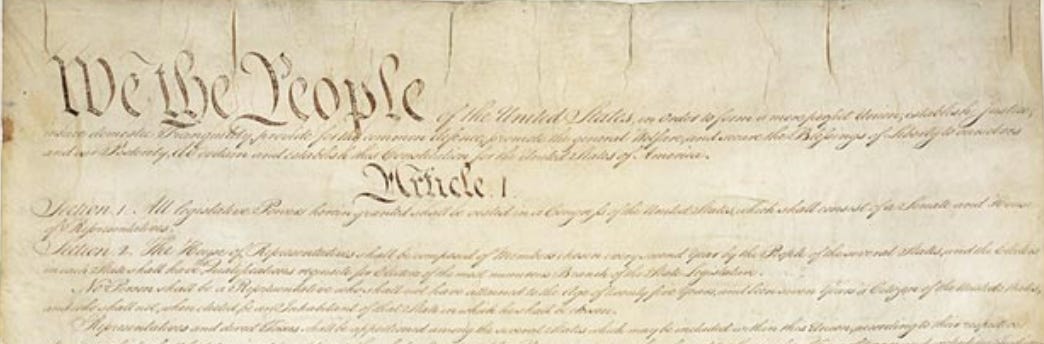
Early in the second Trump administration, the combination of an aggressive Republican president, a supportive conservative Supreme Court, and deferential Republican Congress led to widespread commentary about a hapless Congress. Concern about Congress’s role had been building for years, but it deepened in the second Trump administration as the president asserted broad powers and the Supreme Court often backed the president and expanded its own role. Much of the concern is tied to criticism of congressional Republicans, who were in the majority in both houses in 2025-2026, for failing to stand up to Trump’s excesses or provide a systematic response to court challenges to laws enacted by Congress over the past half century. But Congress’s ability to direct public policy by law, to oversee policy implementation, and resist presidential incursions in its Article I authority were serious concerns in and out of Congress for years before Donald Trump was first elected in 2016. In the eyes of many observers, the Trump era made it a crisis.
Modern presidents have taken increasingly expansive views of their power. Ambiguities in law, the assertion of broader powers to control executive branch agencies and officials, and congressional gridlock created opportunities for a president to fill the void with executive orders, policy clearances in the Office of Management and Budget, and other policy directives. Presidents Reagan, Clinton, Bush, and Obama, Democrats and Republicans, took steps to initiate policies and processes extending beyond current law and took credit from political allies, including members of Congress, for doing so.
On the first day of his second term in 2025 Trump took the strong presidency model to another level by issuing 26 executive orders, 12 presidential memoranda, and four proclamations. Over the next two years Trump took dozens of actions that many in Congress and outsiders considered either violations of the Constitution or law and in a manner that undermined Congress’s role. Some of these presidential actions have not survived court challenges and many of them are still pending in the courts. A partial list is provided in Table 46-1.
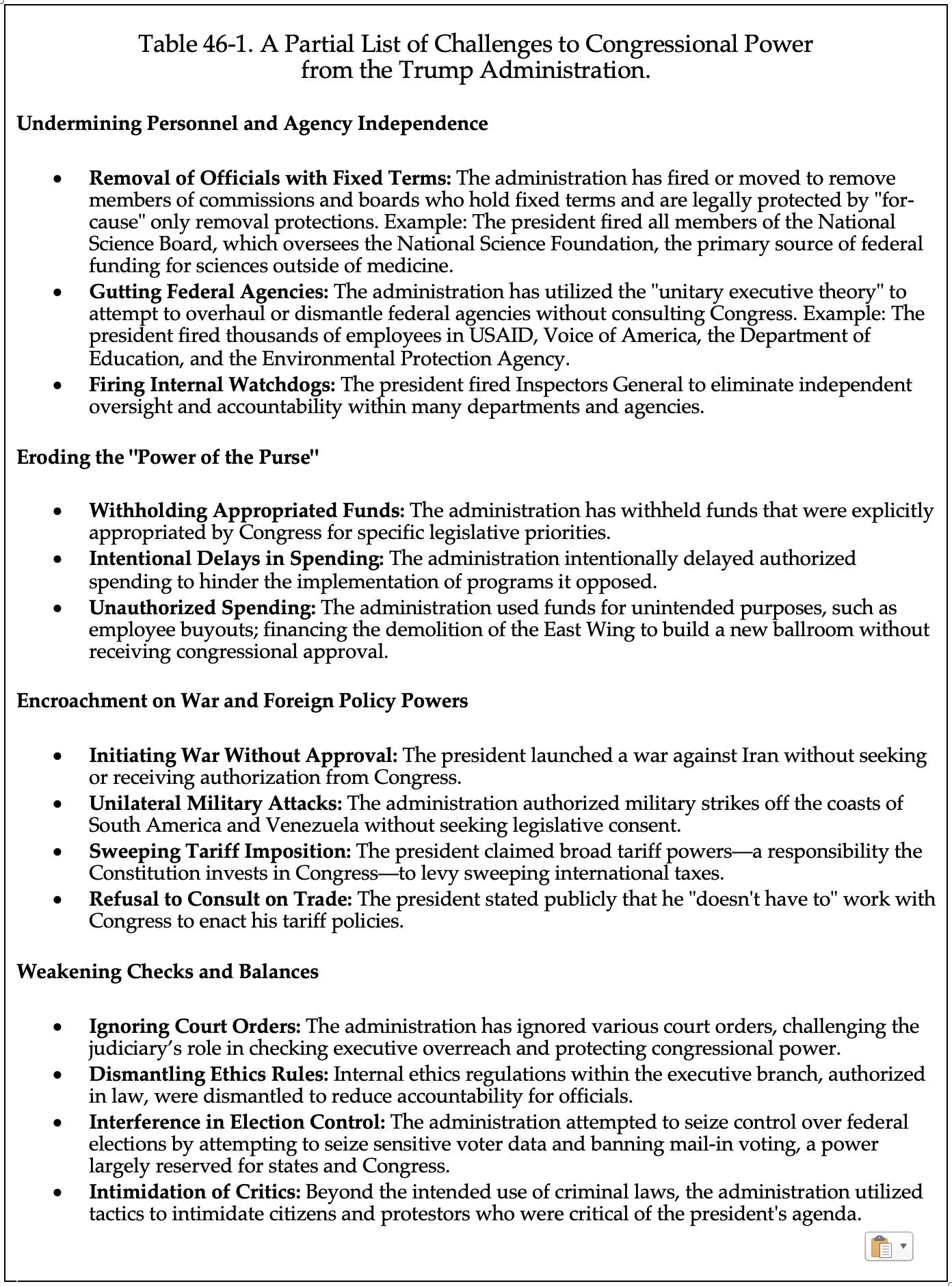
These actions reflect the administration’s embrace of the “unitary executive theory.” Collectively, they represent an unprecedented and willful disregard for constitutional and statutory limits on presidential power. They encompass to more policy domains and assert a wider stretching of presidential power than occurred in other recent administrations. Indeed, the unitary executive theory, a constitutional interpretation advocated for years by conservative legal scholars, provides that all executive authority is given to the president. In this view, president’s power to fire and order action by executive branch officials supersedes statutes (passed by Congress, signed by a president) that grant rule- or policy-making authority directly to executive branch agencies and protect them from political intervention by the president. The unitary executive principle does not represent the views of most legal and historical scholars, but it held sway among important advisors to President George W. Bush (2001-2009) and appears to guide nearly all top administration officials in the second Trump term.
Can Congress Respond?
Commentators occasionally claim that presidents’ unilateral actions are a by-product of Congresses failure to act. The gridlock in Congress, rooted in polarized, evenly-matched parties and the Senate filibuster, creates an opening for the president to act unilaterally. If the president’s actions are popular, even if they encroach upon Congress’s authority, Congress is unlikely to take corrective action. This argument has merit, but in Trump’s administration, top officials endorse unitary executive theory, which denies that any corrective action the Congress might take cannot abridge the president’s power to control the personnel and policies of executive departments and agencies.
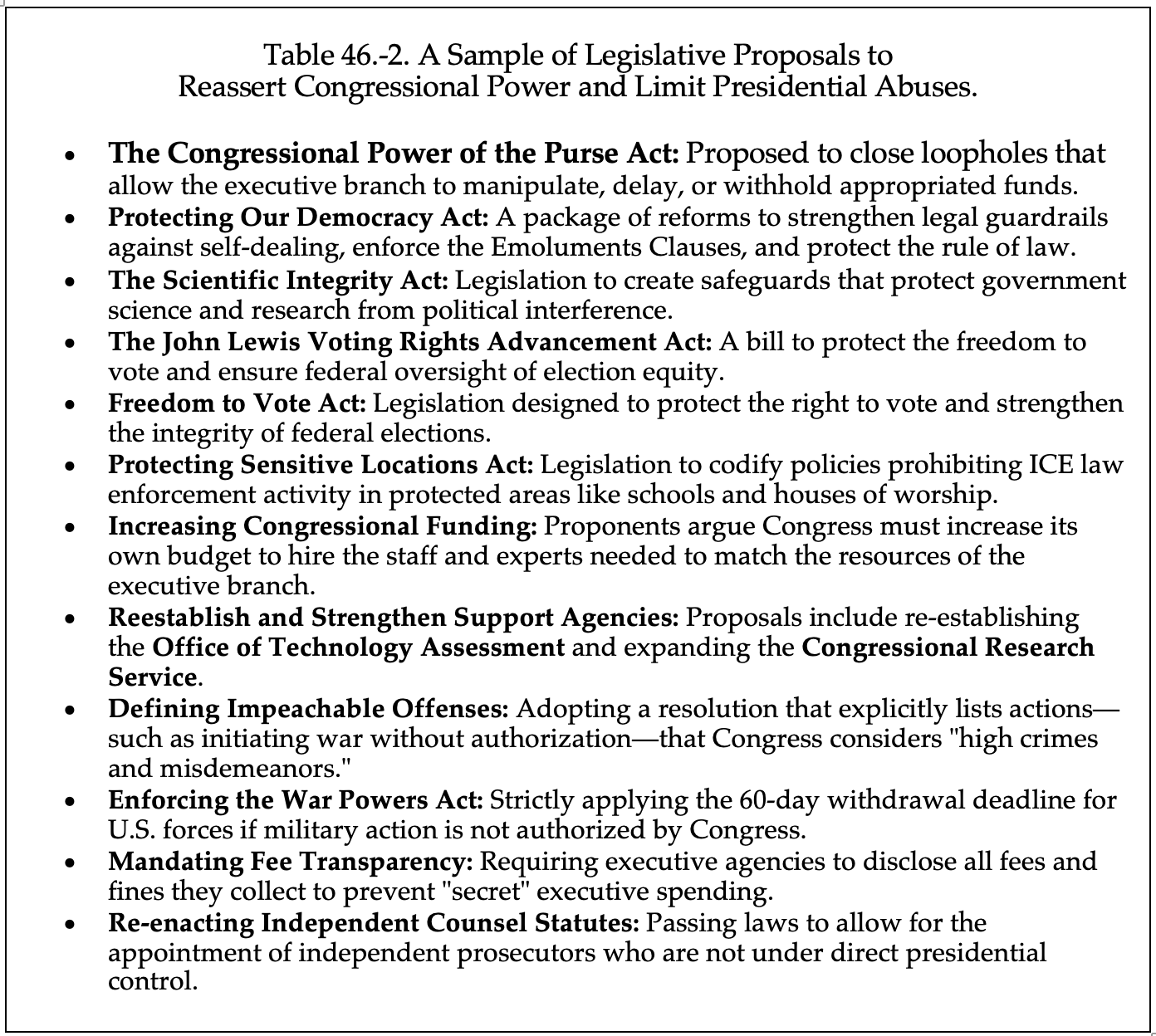
Nevertheless, members of Congress—primarily Democrats—and outsiders have accumulated a sizable list of legislation intended to reassert congressional influence. The sheer volume of presidential moves challenging congressional power has necessarily generated a wide range of legislative proposals. A short list of proposals is listed in Table 46-2. None have been enacted as of this writing in 2026.
While meaningful action on these proposals awaits a new Congress in 2027, challenges to Trump’s actions will continue to make their way to the Supreme Court, but, at this writing in mid-2026, it is too early to know how far the president will be allowed to go. In dozens of cases, lower court judges have blocked or delayed implementation of executive orders and other administration actions, but the Supreme Court, often issuing orders to counter lower court rulings without providing its reasoning, has sided with the Trump administration far more often than not.
In the meantime, majority Republicans of the 119th Congress (2025-2026) showed few signs of interest in challenging the president by conducting hearings to scrutinize administration actions, enacting appropriations conditional on meeting congressional expectations, withholding spending authority until the president relents on certain issues, refusing to confirm presidential nominees, or impeaching and removing the president from office.
The Supreme Court Adds to Congress’s Problems
Complicating matters for advocates of restoring congressional power is the Supreme Court’s 5-4 or 6-3 conservative advantage in recent decades. The Court moved away from showing deference to Congress and the president by asserting more authority for itself to decide questions about the power of Congress and the presidency. While the Court sometimes overturned actions of the president, Congress has been the clear loser. The current Court has ruled to increase presidential supremacy over the executive branch and the implementation of policy, often at the expense of the plain meaning of laws enacted by Congress and past presidents. The five issues addressed in Table 46-3 illustrate ways the Court has acted to limit congressional power in important ways.
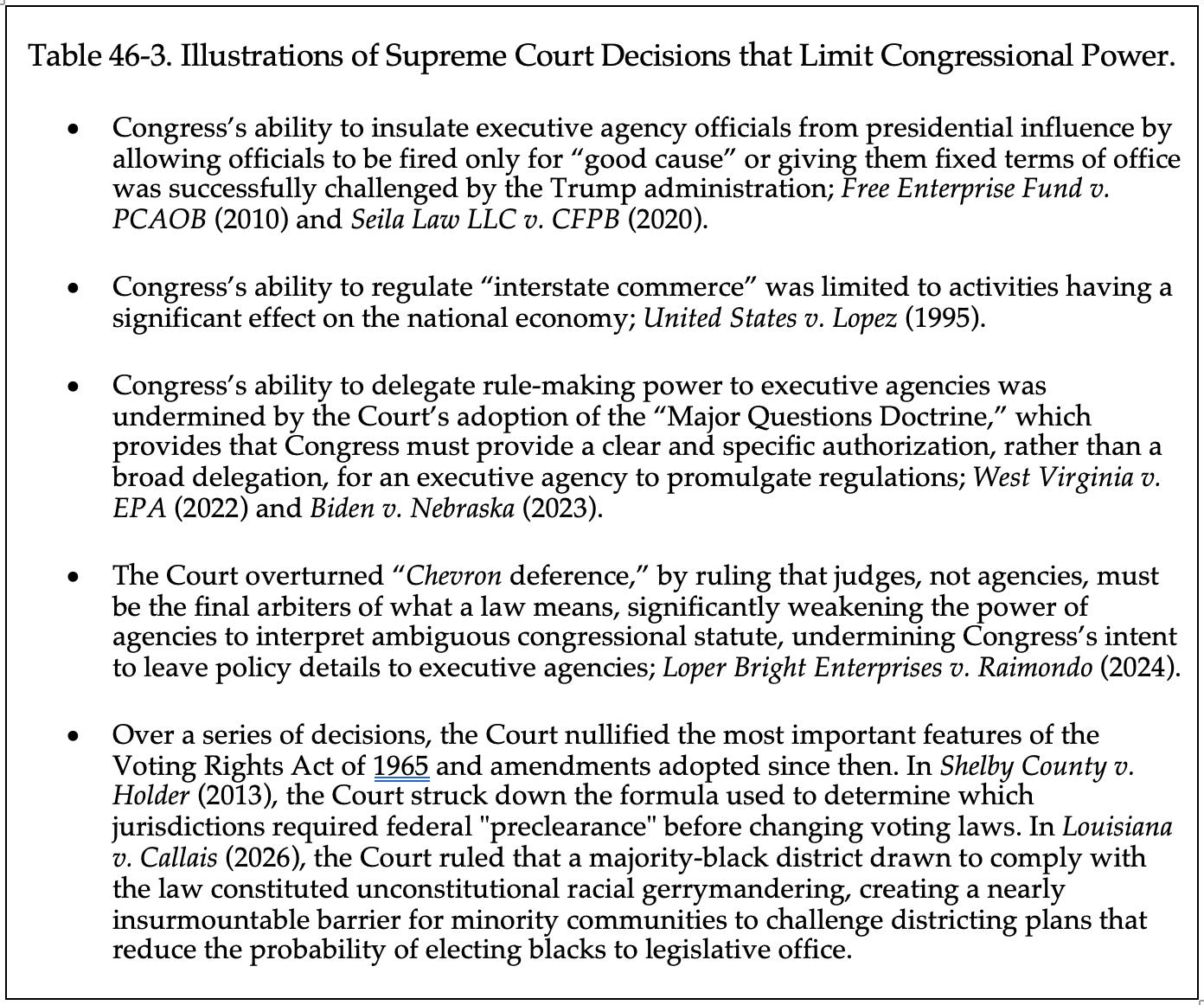
These actions limit Congress’s ability to establish federal policy, structure executive agencies, and assign policy-making authority to them, leaving the courts with more influence over defining the scope of congressional power and giving the president greater influence over agency personnel and regulatory decisions. An important exception is Learning Resources, Inc. v. Trump (2026), in which the Supreme Court clarified that the International Emergency Economic Powers Act (IEEPA) does not grant the President open-ended authority to declare an emergency and impose tariffs. But that ruling is an exception to the overwhelming balance of case law limiting congressional options in creating federal programs.[1]
The Court’s actions, combined with an administration that abides by the unitary executive theory, produces a fundamentally different institutional environment for Congress. Even when the Court limits presidential power, it may do so in a way that also limits Congress’s ability to establish program missions and set policies for hiring and firing personnel. At least early in the second Trump administration, the Republican majorities in the House and Senate have accepted the situation with little response.
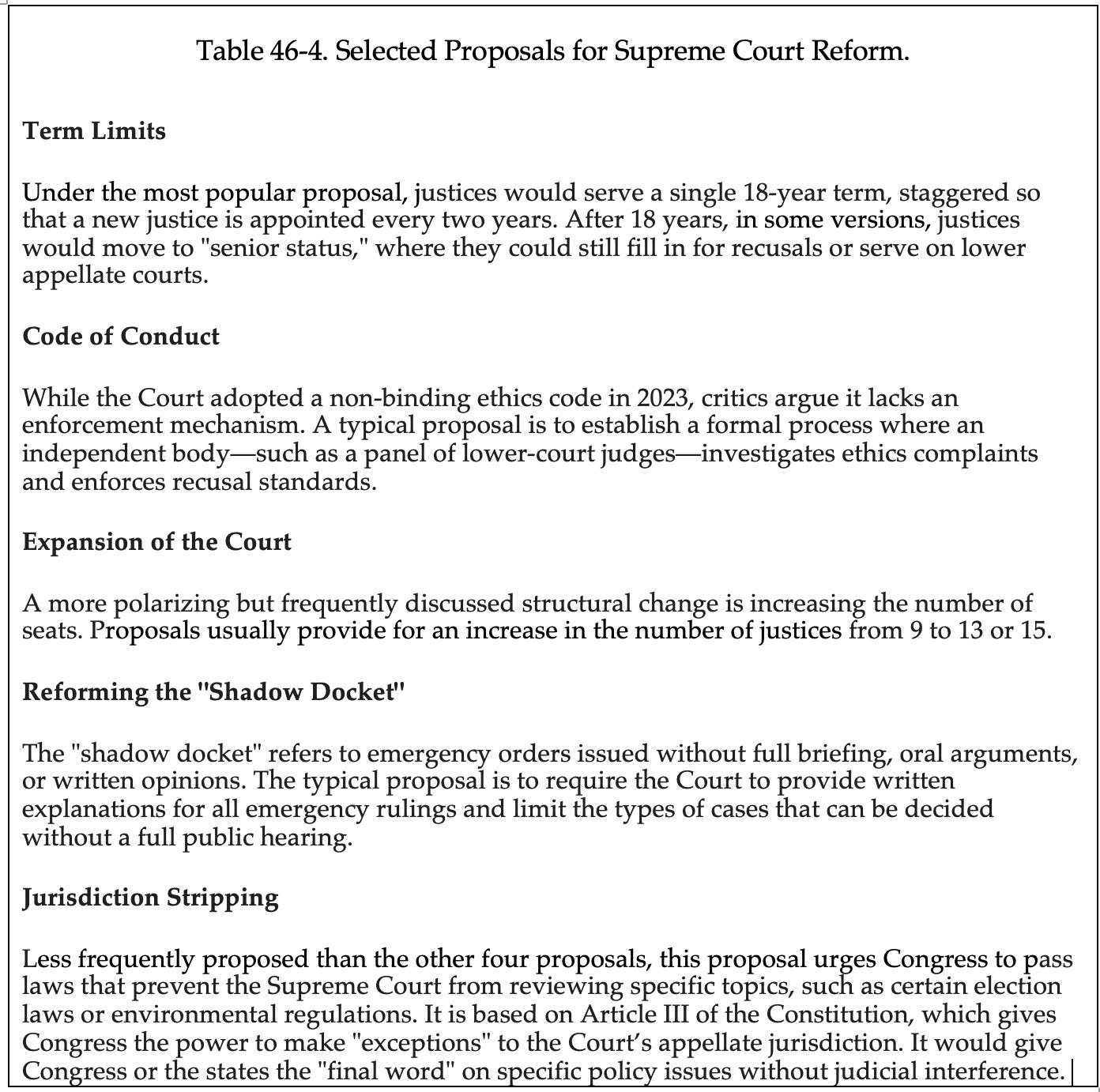
Experience with today’s partisan Court has revived interest in court reform. Table 46-4 summarizes the most discussed proposals. Term limits require a constitutional amendment and so its adoption is unlikely. Congress can adopt the other proposals through legislation, although minority obstruction and the high threshold for cloture in the Senate make adoption of any significant reform unlikely in the foreseeable future.
What We Should Think About All of This?
The separation of powers is not a self-correcting equilibrium; it is a dynamic, high-stakes game of institutional strategy. As Madison intended in Federalist 51, the system’s health depends entirely on members of Congress prioritizing their ‘procedural turf’ and institutional prerogatives over temporary partisan gains. In the modern era, we see a dangerous ‘hollowing out’ of the legislative branch when members act as member of partisan teams rather than autonomous policymakers.. This isn’t just a breakdown in civility; it is a structural failure of the steering mechanism of our democracy. Legislators and their leaders must recognize that surrendering policy control to the executive is an existential threat to the very legitimacy and relevance of the Congress.
Realistically, we can expect legislators to defend Congress when their personal political interests are in sync with collective institutional interests. When the partisan divide is deep and wide, when neither party holds a congressional majority for long, when national party reputations dominate local concerns in the minds of voters, and when a president holds extraordinary influence over his partisans, we can expect discontinuity in congressional self-defense and regular exploitation of the situation by presidents.
In our current condition, the American system is at risk.
[1] I am setting aside the dozens of federal courts cases on immigration and deportation, many of which block Trump administration actions.
These tables cut right through all of the undergrowth of the daily news and reveals the basic institutional issues of our governmental crisis; many thanks.