
Note 47. Presidents and Filibuster Reform

For most of the 20th century, a strict norm governed the relationship between the White House and Senate procedure: Presidents stay out of Senate rules. The Senate was viewed as an autonomous institutional body, fiercely protective of its parliamentary traditions—particularly Rule 22 and the filibuster. Executive interference in internal Senate procedures was considered not only bad manners, but politically counterproductive.
Yet over recent decades, as partisan polarization has intensified and legislative agendas have nationalized around presidential priorities, this boundary has dissolved. The story of presidential views on filibuster reform from John F. Kennedy to Joe Biden and Donald Trump is an institutional chronicle of how chief executives transitioned from cautious deference to active strategic manipulation—and ultimately, to demanding the wholesale destruction of the Senate’s iconic supermajority requirement.
Woodrow Wilson
As both a political scientist examining legislative architecture and a president facing international crisis, President Woodrow Wilson viewed the chamber’s practice of unlimited debate not as a noble safeguard of minority rights, but as an institutional pathology that systematically subverted responsible government. The breaking point arrived in March 1917, when a tiny coalition of senators successfully filibustered the Armed Ship Bill at the close of the 64th Congress, denying the executive authority to arm U.S. merchant vessels against German submarine warfare. Seeking to mobilize public support for filibuster reform, Wilson famously declared that a "little group of willful men, representing no opinion but their own, have rendered the great government of the United States helpless and contemptible." By mobilizing public anger against parliamentary obstruction during wartime, Wilson engineered the external leverage necessary to overcome internal Senate resistance. This pressure campaign directly forced the chamber's leadership to adopt Rule 22, establishing the Senate’s first formal cloture mechanism.
The Era of Institutional Deference and Strategic Coalition-Building (1961–1979)
The filibuster remained an obstacle to the enactment of presidents’ legislative proposals, but it was generally reserved for civil rights legislation. Sporadic, but intense, efforts by civil rights advocates to reform had modest effect, but by 1960 little had been accomplished. In the 1960s, presidents understood that while the filibuster blocked key elements of their domestic agendas, attempting to alter Senate rules directly was a high-risk proposition. Senators whose support presidents needed for their legislative priorities made clear that they would resent a president’s effort to mobilize the public against rules they wanted to retain.
John F. Kennedy supported lower cloture thresholds in principle, having voted for procedural reforms during his tenure in the Senate. Yet as President, Kennedy explicitly chose not to throw executive weight behind the opening-day Rule 22 battles in 1961 and 1963. Kennedy’s calculus was purely tactical: he needed the cooperation of powerful Southern Democratic committee chairmen to pass tax cuts and economic programs. Torpedoing his relationship with Senate barons over a rules fight on civil rights legislation may have crippled his broader legislative agenda.
Lyndon B. Johnson took a different route altogether: mastering the existing rules rather than trying to rewrite them from the Oval Office. Having orchestrated the 1959 modification of Rule 22 as Majority Leader—which lowered the cloture threshold from two-thirds of the entire Senate to two-thirds of senators present and voting—LBJ recognized that the filibuster was fundamentally a coalition-building problem. Rather than attacking the rules, President Johnson leveraged executive patronage, public opinion, and a historic alliance with Republican Leader Everett Dirksen to assemble the 67 votes necessary to break the landmark Southern filibusters against the Civil Rights Act of 1964 and the Voting Rights Act of 1965.
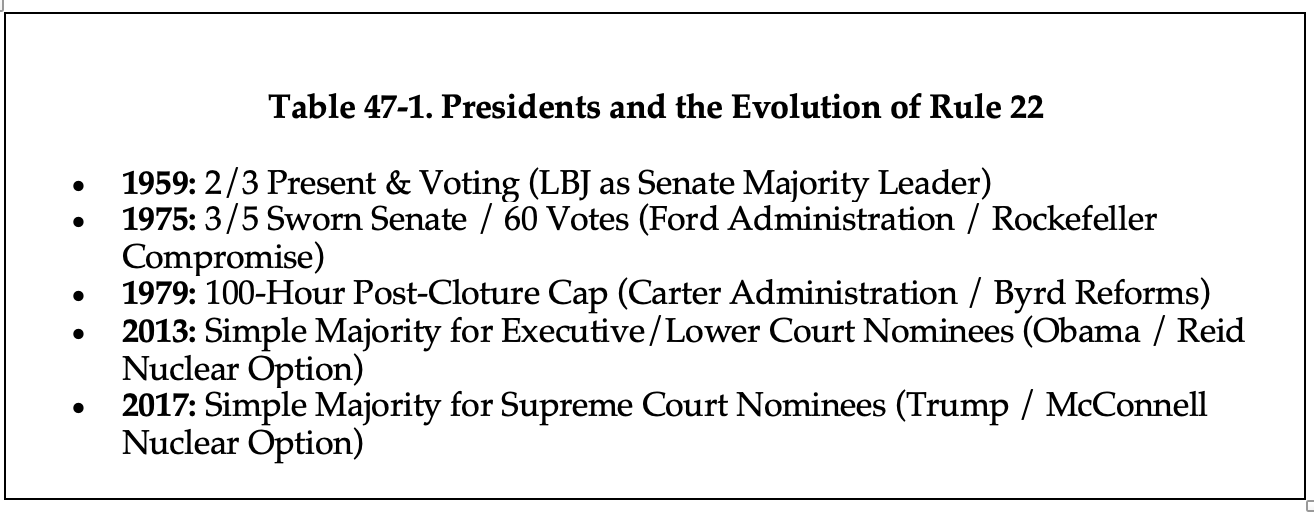
By the mid-1970s, procedural friction reached a breaking point. Gerald Ford’s administration saw Vice President Nelson Rockefeller sustain a pivotal procedural ruling in 1975 establishing that a simple majority could alter Senate rules at the start of a Congress—the original “constitutional option.” To head off institutional chaos, the Senate reached a compromise that permanently lowered the cloture threshold from a two-thirds supermajority to three-fifths of the sworn Senate (60 votes).
Jimmy Carter experienced the limits of this new 60-vote world when conservative filibusters derailed his labor and energy initiatives. Rather than attempting to lower the 60-vote threshold, Carter quietly backed Senate Majority Leader Robert Byrd’s 1979 procedural reform, which placed a 100-hour cap on post-cloture debate to curb the growing practice of post-cloture filibustering.
Bypassing Rule 22: The Shift to Procedural Workarounds (1981–2000)
As polarization grew in the 1980s and 1990s, presidents realized they did not need to win a formal fight over Rule 22 when they could bypass it, as fellow partisans urged, by using the reconciliation process created by the Budget Act of 1974.
Ronald Reagan eagerly supported the efforts of congressional Republicans to squeeze much of his program into reconciliation bills. By channeling his domestic program cuts and defense increases through a reconciliation bill (Omnibus Budget Reconciliation Act of 1981), Republicans and a few Democrats pushed their sweeping economic legislation through the House, which had a Democratic majority, and side-stepped the 60-vote filibuster threshold in the Senate, passing the measure with simple majorities in both houses.
George H.W. Bush faced a Democrat-controlled Senate that blocked much of his program. Bush largely avoided pushing for Senate rule changes, relying instead on the negative power of the executive veto—issuing 44 vetoes across his single term to control the legislative agenda without touching Rule 22. A veto override, of course, requires a two-thirds majority on each house, even higher than the three-fifths majority for cloture.
Bill Clinton sharply criticized Republican gridlock after GOP minority filibusters sank his $16 billion economic stimulus plan in 1993 and then his healthcare plan in 1994. Remarkably, Clinton refrained from demanding structural changes to Rule 22. After 1994, Clinton faced Republican majorities in the Senate, which killed Democratic enthusiasm for filibuster reform. Indeed, it was Senate Republicans who began to discuss ways to reform or circumvent the filibuster and stimulated a search for workarounds that would carry into the new century. Clinton adapted through tactical compromises, recess appointments, and budget reconciliation packages.
The Breakdown of Norms: The Nuclear Era (2001–Present)
The 21st century marked an aggressive turn toward direct executive intervention in Senate procedure, driven primarily by judicial nomination battles.
George W. Bush broke long-standing precedent during his first term when Senate Democrats filibustered ten conservative appellate court nominees. Bush publicly campaigned for procedural reform, asserting that all presidential nominees were constitutionally entitled to an “up-or-down vote.” He openly endorsed Senate Majority Leader Bill Frist’s threat to deploy the “nuclear option”—changing Senate rules by simple majority vote. The crisis was temporarily averted in May 2005 by the bipartisan “Gang of 14,” but the boundary separating executive pressure from Senate rulemaking was permanently crossed.
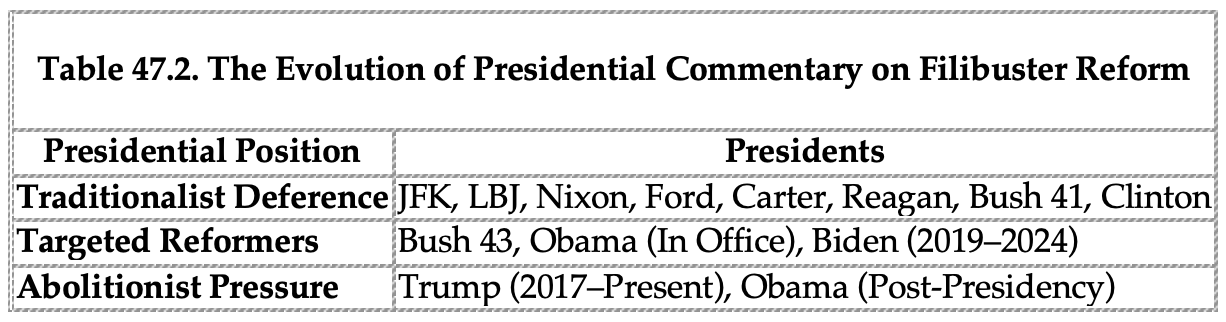
Barack Obama initially defended the filibuster as a senator, even participating in a 2006 filibuster against Supreme Court nominee Samuel Alito. However, faced with unprecedented minority obstruction of judicial and executive appointments during his presidency, Obama backed Senate Majority Leader Harry Reid’s November 2013 decision to trigger the nuclear option. This eliminated the 60-vote threshold for lower court judges and executive nominees. Years later, at John Lewis’s July 2020 funeral, Obama took his stance a step further, calling the legislative filibuster a “Jim Crow relic” and advocating for its complete removal to pass federal voting rights laws.
Joe Biden’s Institutional Evolution
Joe Biden’s posture toward the filibuster underwent a methodical shift between 2019 and 2024, reflecting the tension between his identity as a traditional institutionalist and the pressures of party-government accountability. Launching his presidential campaign in April 2019, Biden leaned heavily into his 36-year tenure as a U.S. Senator, rejecting calls from progressive primary contenders—such as Elizabeth Warren and Bernie Sanders—who advocated for the immediate abolition of Rule 22. Biden maintained that bipartisan cooperation could be restored once Donald Trump left office, arguing that dismantling supermajority requirements would destabilize Senate norms and invite retaliatory rule changes when Republicans eventually regained control.
However, as the 2020 Democratic primary season progressed, candidate Biden began to adjust his position under mounting pressure from voting rights advocates and progressive interest groups. By July 2020, Biden made a notable shift in an interview with reporter groups, stating that while he hoped to avoid eliminating the filibuster, his decision would ultimately depend on Republican behavior. Biden conceded that if Senate Republicans engaged in systemic obstruction against presidential priority measures, Democrats would have to “take a look” at reforming or eliminating the 60-vote threshold.
Once in office, President Biden’s public stance moved from conditional open-mindedness to explicit reform proposals. Facing Republican filibusters against major Democratic legislative initiatives, including the For the People Act and the John Lewis Voting Rights Advancement Act, Biden formally endorsed procedural changes in March 2021 by expressing support for restoring the historic “talking filibuster”—requiring opposing senators to physically hold the floor continuously to delay legislation. By January 2022, during a speech in Atlanta, Biden escalated his stance, explicitly advocating for a targeted, single-issue carve-out from the 60-vote threshold to pass voting rights legislation with a simple majority. Following the Supreme Court’s decision to overturn Roe v. Wade in June 2022, Biden extended his call for a filibuster carve-out to codify federal abortion protections.
Donald Trump’s Campaign for Filibuster Abolition
Donald Trump exhibited no hesitation about demanding change in Senate filibuster rules. During his first presidential term, Trump repeatedly broke with Senate Majority Leader Mitch McConnell, issuing over 30 public statements and social media posts between 2017 and 2018 demanding the total abolition of the legislative filibuster. Trump argued that retaining the 60-vote rule surrendered effective control of the Senate to the Democratic minority, blocking presidential priorities such as border wall funding, immigration enforcement, and federal spending bills.
Trump, of course, enthusiastically backed McConnell’s April 2017 deployment of the “nuclear option” to lower the cloture threshold for Supreme Court justices from 60 votes to a simple majority, enabling the confirmation of Neil Gorsuch, Brett Kavanaugh, and Amy Coney Barrett. This established a pattern of leveraging executive pressure against parliamentary traditions whenever internal Senate procedures interfered with executive policy goals.
Trump has intensified his direct public pressure on Senate leadership to dismantle the legislative filibuster entirely. Directing explicit demands toward Senate Majority Leader John Thune, Trump ordered Senate Republicans to remain in session rather than taking a planned recess until they passed federal voting legislation or eliminated Rule 22. On July 27, 2026, Trump posted on Truth Social:
John Thune should not allow the United States Senate to ‘leave town’ until it passes The Save America Act or, far better still, TERMINATES THE FILIBUSTER, where Republicans can then quickly pass everything they ever dreamed of, including a full and deep throated SAVE AMERICA ACT, the Budget, and the ever looming Debt Ceiling disaster, 1929! The Dumocrats will do it on day one, and can’t believe how lucky they got with this Senate leadership. Remember, stupidity always brings LOSING & DEATH! President DJT
By linking the elimination of the filibuster directly to major legislative initiatives—including the SAVE America Act, federal budgetary appropriations, and debt ceiling negotiations—Trump framed Rule 22 as an unacceptable obstacle to executive-led party governance. In public remarks in Georgia preceding his post, Trump warned supporters that a legislative “stoppage in September” was imminent unless Republicans terminated the filibuster to pass voter identification and proof-of-citizenship requirements.
Conclusion
Presidents invest in their legacies, which, in major part, turn on their standing with the public, their parties’ electoral successes, and, of course, their legislative successes. As the Senate filibuster transformed from a rare tool for extended debate into a routine veto gate, presidents resented its effects and, in the last three decades, openly protested minority rule in the Senate. To be sure, presidents often appreciated the ability of senators on their side to block legislation and sparing them from having to veto legislation. From Woodrow Wilson departure to Donald Trump’s second term, presidents did not engage in sustain efforts to persuade senators to reform Senate rules. President Trump, more than any president since Wilson, came to view Rule 22 not as a sacred traditional feature of the Senate but instead as an intolerable barrier to his political success.
Trump, of course, has discovered that the views of many senators of his own party did not jibe with his own. As a general rule, Senate conservatives want to preserve the super-majority threshold for cloture in order to set a higher bar for enacting new federal programs. To be sure, the high threshold makes it difficult to dismantle existing programs, but simple-majority reconciliation and unilateral action by presidents often are viable options for cutting programs. All recent Senate Republican leaders have opposed reforming the filibuster for regular legislation. John Thune emphatically opposed reforming the “legislative filibuster” while running for floor leader and while serving as majority leader since early 2025.
Trump, of course, may be a special case. While he certainly is a partisan and his criticism of the filibuster fits a trend in presidential views, Trump’s frequent commentary about Senate Thune’s leadership also fit a Trump pattern of expecting personal loyalty. On July 27, 2026, Trump not only posted critical comments about Thune; he also urged his followers to “call Thune at the Senate” to put additional pressure on him to “nuke” the filibuster in order to pass the SAVE Act. This was an extraordinary request that reflects Trump’s less-than-cooperative relationship with Senate Republican leadership. While Trump quickly responded to criticism by indicating that he had a great relationship with Thune, the tension between a president and his own partisans over Senate procedure is unprecedented.